
BY RYAN E. SMITH
BLADE STAFF WRITER
Over the years, Barbie has been an actress, a ballerina, and a concert pianist.
She's been a doctor, a Formula One driver, and a provocateur to feminists.
But she has never, ever been middle-aged. Until now. That's right, the top-selling doll and icon of fabulous fashion is about to turn 50.
Barbie was created in 1959 by Ruth Handler, the 10th child of Jewish Polish immigrants, after she noticed her daughter, Barbara, using paper dolls to play adult and teenage make-believe and saw a void in the market.
"At the time it was developed in the '50s, the only dolls for little girls to really manipulate and play with were baby dolls, so they could only plan to be one thing — mommies," explained Robin Gerber, author of the book, Barbie and Ruth: The Story of the World's Most Famous Doll and the Woman Who Created Her.
"That was Ruth's great concept: Little girls want to play at being bigger girls, but we don't have to tell them exactly what to be."

So the co-founder of Mattel devised a doll, based on one that she saw in Germany, that had all the curves of a woman, including breasts, and could wear a variety of interchangeable outfits.
The final product unveiled March 9, 1959 at Toy Fair in New York was Barbie the Teenage Fashion Model. With her hair in a pony tail, she wore a black-and-white striped swimsuit and glamorous, golden hoop earrings. Consumers responded by buying 300,000 of them in the first year at $3 apiece.
Doll collector Patsy McGinnis, 77, of Napoleon, still recalls her reaction to seeing Barbie for the first time.
"I remembered thinking when my daughters were little: that doesn't look like a baby doll to me," she said. "I wish I had bought some of the first ones." (An original in mint condition would sell for nearly $27,500 now.)
She's everywhere
Barbie's first boyfriend Ken, named after Ruth Handler's son, was introduced two years later, and more family members and friends followed as the decades progressed. The fashionista even got a backstory: Her real name is Barbie Millicent Roberts and she's from Willows, Wisc.
Today, Barbie is everywhere. Ninety percent of American girls between the ages of 3 and 10 own at least one of the dolls, according to Mattel. If you look only between the ages of 3 and 6, the average girl owns 12.
One key to Barbie's lasting popularity is her continued ability to reflect the times and be a trendsetter.
"She always has the hottest career, the hottest accessories, whether it's a car or a cruise ship or whatever," said Reyne Rice, a toy trend specialist with the Toy Industry Association, the trade organization for North American toy manufacturers.
Before a man set foot on the moon, Barbie was an astronaut. When First Lady Jacqueline Kennedy sported a bouffant hairdo, so did Barbie.
Barbie's life hasn't been without missteps, though. There was the talking doll that said, "Math class is tough!" and one version of her sister Skipper who grew breasts if her arm rotated.
Mostly, though, there's been the lingering controversy over the body image that some say the thin-waisted doll promotes. Critics call Barbie a poor and unrealistic role model and have contended that her measurements wouldn't be humanly possible if she were full-sized. (Others have pegged her at about 39-21-33.)
"If a woman had the measurements of a Barbie doll, she would not be able to walk upright," said Charlene Gilbert, director of the Catharine S. Eberly Center for Women at the University of Toledo.
While Barbie does come in different skin tones now — the first African-American Barbie was introduced in 1980 and she has represented 50 nations over the years — the dolls should represent diversity in even more ways, including height and weight, Ms. Gilbert said.
"Providing a spectrum of what is beautiful in the world is really important," she said.
The toy's maker essentially maintain's Ruth Handler's stance on this issue.
"At the end of the day, Barbie's a doll. She can't really be compared to the female body type," said Stephanie Cota, senior vice president for Barbie brand marketing at Mattel.
The more important thing, she continued, is that "girls see Barbie as a way to play out their inspiration. She opens up a world of possibilities to them."
Becca Cragin, assistant professor in the popular culture department at Bowling Green State University, agreed that the doll can act as a blank slate for girls.
"They really just use it as a vehicle to invest with their own stories and their own behavior," she said. "Even if it is a distorted body image, it's just one of a million around us. ... The doll itself is very unrealistic, but most dolls are."
The fact that Barbie has tried so many vocations over the years actually makes her an empowering force, according to Mrs. McGinnis, a past president of the Toledo Glass City Doll Collectors Club, whose annual doll show will be March 29 at the Stranahan Great Hall.
"You do get caught up in Barbie [as] the doll that can do anything," she said. "I do feel that the little girls think, 'Oh boy. If Barbie can do it, Barbie can do anything. We girls can do anything.'"
Mrs. McGinnis is proof that kids aren't the only ones who have enjoyed Barbie over the years. Adult collectors are legion.
"It's more than just a child's toy," said Nancy Parsons, chairman of the 2009 National Barbie Doll Collectors Convention.
This summer's gathering in Washington is limited to 1,120 people. It sold out in two days, and there are 300 people on the waiting list, she said.
In many ways, Barbie will be celebrating her 50th in an appropriately adult manner. A New York fashion show with Barbie-inspired couture was slated for yesterday, and a party at a beachside "Malibu Dream House" is on tap for her actual birthday.
There are beauty products through Stila cosmetics and special dolls, including re-releases of past favorites like Twist 'N Turn Barbie.
It's a reminder that a lot has changed over the years, but not her stunning youth and beauty.
"She looks pretty good for 50," said Karen Rohrs, of Maumee, during a recent visit to Toys R Us on Reynolds Road. She was there with her granddaughter, Bailey, of Lakewood, Ohio, who was on the prowl for the perfect gift for her upcoming fourth birthday.
Crouched in the shopping cart, Bailey peered keenly at the aisle packed full of Barbie dolls, representing just a fraction of the more than 100 careers the doll has had over the years. She passed Barbie for President, Barbie as Rapunzel, Barbie in a bikini, Barbie in a convertible. Finally, she made her pick: Barbie as TV chef.
"When we get home, I'm going to play," she said, embracing the box and collapsing into the shopping cart. "I'm a birthday girl."
Just like Barbie.
Originally published in The Blade on Sunday, February 15, 2009
The doll revolutionized the toy industry



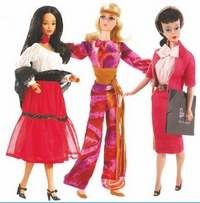

From left, Hispanic Barbie (1980), Live Action Barbie (1971), and Barbie Fashion Designer (1960).