
BY RYAN E. SMITH
BLADE STAFF WRITER
Nothing can get a motorhead’s adrenaline flowing quite like a drag race. So much depends on concentration and reaction time. It’s enough to give one the jitters — even if the cars being raced look like toys.
“You get butterflies,” admitted Andrew Coffey, 21, during a recent competition at Glass City Slot Car Dragway Models and More in West Toledo. “I get that in real racing and in racing slot cars. It just depends on who you race and how much money there is [at stake].”
The idea of slot car racing may conjure childhood memories for many, but to people like Mr. Coffey, a Monroe man who races real cars in the summer, it’s a serious competition with a cash prize awaiting the winner. “It’s a hobby. It keeps me out of trouble.”
The scene at Glass City Slot Car repeats over and over on race days: Pairs of men staring with a quiet focus, mouths slightly open in concentration, as they wait for the green starting light to flash. Then, muscles twitching instinctually, they squeeze the controller, completing the electric circuit to their pint-sized car and sending it screeching down the 27½-foot track in less than a second.
The cars here, which run along a slot in the track, are 1/24th the size of actual vehicles and can cost anywhere from about $30 to $800. (Smaller-scale racers exist as well.) They recreate their larger counterparts in incredible detail, providing perfect miniature versions of dragsters, Camaros, motorcycles, and more. One man even had the Oscar Meyer Wienermobile.

While slot cars date back all the way to about 1900, it was in the 1960s that they really exploded in popularity, according to Robert Schleicher in Slot Car Bible. He writes that there were about a dozen hobby shops with tracks that could be rented in the mid-60s; by 1970 there were more than 4,000 in the United States.
Things have changed since then. Most kids today are more likely to know about the SlotZ Racer application for the iPhone than actual slot racing. Even though technology used in today’s cars far surpasses the older models — some can zip by at more than 100 mph — there’s little question that interest is down.
“With all the other things that are around today for entertainment, we have our place, but it’s definitely a smaller place than what it used to be,” said Doug Bauer, national director of the United Slot Racing Association, which holds two national events each year.
Pat Falgout, owner of Hobby Stop West on West Sylvania Avenue, has seen changes locally as well.
“We really only sell them around Christmas time as kind of a nostalgia toy,” he said.
At Glass City Slot Car on Monroe Street, business used to be brisk, with owner Mike Willard hosting races three times a week. Now competitions only take place on Sundays and last week’s only attracted eight people.
The enthusiastic bunch included Roger Kennedy, 56, and Melvin Woods, Jr., 33, two other men involved in real racing during the summertime.
“It’s something to keep the racing bug going,” said Mr. Kennedy, of Maumee.
There’s a camaraderie aspect to it too, explained Mr. Woods, of the Old West End.
“A slot car [track] is like a bar without beer,” he said. “It’s a place to hang out.”
To hang out with a larger group of racers, Mr. Woods often travels to T.S.S. Hobbies in Belleville, Mich. Drag racing there regularly draws 30 to 40 people and more than 125 cars on a Saturday. One recent weekend, there were more than 350 cars entered and Mr. Woods came away with $800 for finishing in the semifinals.
Still, he’s not going to let the success go to his head.
“You could be the best in the world and there could be some little kid who could beat you.”
Originally published in The Blade on Sunday, February 1, 2009
Slot races, a ’60s hit, still thrill hobbyists
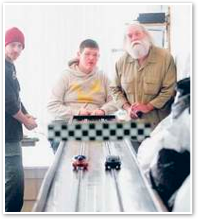
Rob Wilson, left, and Roger Kennedy, right, watch as their slot cars race down the track while Andrew Coffey, center, observes. (THE BLADE/AMY E. VOIGT)