
BY RYAN E. SMITH
BLADE STAFF WRITER
You could say this was the Year of the Cartoon. Some of the biggest names ever to be animated celebrated milestone birthdays in 2009, even though they may not look their age.
Popeye is 80. Scooby-Doo is 40. The Simpsons is 20. And that’s not the half of it.
Wile E. Coyote and the Road Runner are 60. Rocky and Bullwinkle are 50.
Coincidence? Who cares. Connect the dots among these cartoon hall of famers and you’ve got an extraordinary window on the evolution of the art form.
Start way back with Felix the Cat. Nine decades ago when cartoon shorts more closely resembled flip books of comic strip panels than modern movies, Felix was born into the silent film era and became hugely popular. A simply designed character with a plucky spirit, he was Mickey Mouse before there was Mickey Mouse, clearing a path for the cheery rodent to follow.
"I don’t think the Disney empire happens without him," said Andrew Farago, curator of the Cartoon Art Museum in San Francisco.
Synchronized-sound cartoons, ushered in by Mickey with 1928’s Steamboat Willie, changed everything. Suddenly animators weren’t limited to word bubbles and pantomime. While Felix had trouble adapting, others such as Popeye — introduced in a comic 80 years ago and a hit on the big screen — took full advantage. They used voices and sound effects to add humor and more.
"The one thing about sound was they were able to have more distinctive and defined personalities," said Jeff Lenburg, author of The Encyclopedia of Animated Cartoons, Third Edition. "It really became personality animation."
That opened up all kinds of opportunities for animators and new characters, among them Betty Boop and Donald Duck, who celebrated his 75th birthday this year. Mel Blanc made a career out of using his voice to add personality to everyone from Porky Pig to Bugs Bunny over the years.
Many of these characters took part in formulaic but popular plotlines.
"A lot of them followed the same basic story. It’s something following something else," explained Charles Coletta, instructor of popular culture at Bowling Green State University.
There are infinite variations to the "chase" theme. Anyone who has seen a Tom and Jerry cartoon knows this. Some of the purest examples were the Warner Brothers cartoons featuring the Road Runner and Wile E. Coyote, who debuted 60 years ago in 1949. They entertained viewers as the coyote always tried (and failed) to catch his prey using innumerable gadgets and tricks.
In the industry’s early years, cartoons were shown mostly as shorts prior to full-length features at the theater, where all ages were exposed to them. They became less profitable following a Supreme Court ruling that changed booking practices. Studios started to cut back and adopted a more limited style of animation that used fewer cels to animate characters and sequences, Mr. Lenburg said.
While Disney stuck around as the dominant player in full-length, theatrical animation releases, many cartoon studios moved to television, where they used this more limited style. (Disney did expand to TV as well.) The result can be seen in the many Hanna-Barbera creations (Yogi Bear, Huckleberry Hound) and the unsophisticated style of Rocky and Bullwinkle, who turned 50 this year. It’s a far cry from the majesty of the lush drawings of Snow White and the Seven Dwarfs. What the cartoon moose and flying squirrel lacked in artistic value, however, they made up for with more sophisticated humor.
"They have what looks like a very simple, funny animal cartoon, but they actually used it to comment on political figures and American society and managed to do it under the radar because it has the appearance of a simple kids cartoon," Mr. Farago said.
By bringing cartoons into the home, television allowed animators new possibilities and audiences. Specifically targeting children, who were home on Saturday mornings or after school, was what made a show like 1969’s Scooby-Doo, Where Are You! so successful.
"Scooby-Doo really didn’t strive for anything beyond creating a program that will be entertaining for kids," Mr. Farago said of the show about a dog and a crew of teenage mystery-solvers. "They really don’t care about reaching the adult audience because the kid audience is constantly replenishing itself. ... Scooby-Doo in 1969 appealed to 5-to-10-year-olds. In 2009, it still appeals to 5-to-10-year-olds."
Contrast that with the much more mature show, The Simpsons, whose first season about a dysfunctional family started in 1989, even though the characters had been introduced earlier. With its anti-establishment mentality and "eat my shorts" catchphrase, the show got adults’ attention right away. Schools banned T-shirts featuring it; parents prevented their kids from watching.
Yet it had something for everyone, including some of the best writing on television. College students especially were drawn to it, and the show proved again that cartoons could make a splash in primetime, reminiscent of The Flintsones’ run in the 1960s.
"I think you could watch The Simpsons with a 5-year-old and a 55-year-old and everyone in between and they would each laugh at something different within the episode," Mr. Coletta said. "I think The Simpsons sort of really did make animation respectable for the masses."
It also led to a proliferation of cartoons trying to push the envelope — society’s and the censors’ — even further. Think South Park and some of the programs on the Cartoon Network’s Adult Swim. The most popular cartoon among Mr. Coletta’s students currently is Family Guy, which joins the more tot-friendly SpongeBob SquarePants in celebrating the 10th anniversary of its debut this year.
Even if they are seen as silly, irreverent, or even crude, modern cartoons like The Simpsons and Family Guy are worth noting because of their topical humor, the BGSU instructor said.
"They’re hitting on the issues of the day much more so than these reality shows are or these dancing shows are," Mr. Coletta said.
The question for Mr. Lenburg is whether that timeliness will allow them to remain accessible from one generation to the next — like Scooby-Doo — or leave them hopelessly dated.
"I look at some of today’s stuff and I’m not certain whether it will have that same legacy," he said. "The Simpsons [made it] far longer than I thought they would."
Originally published in The Blade on Sunday, December 20, 2009

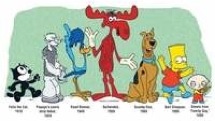

From ‘The Simpsons’ to Popeye, the medium continues to thrive