
BY RYAN E. SMITH
BLADE STAFF WRITER
There are a handful of guys bellied up to the bar at the Loyal Order of Moose, Lodge 713, as the clock strikes 6 on a typical Thursday night.
The TV is tuned to Animal Planet, while an actual moose head looks down from the wall. Beer is on special for $1.50, the jukebox is playing something by the Hollies, and Nicole Rusek is feeling good.
“Everybody gets along here. It’s pretty sweet,” she says as she tends bar. “I’ve never belonged to a club or anything before. Belonging here is pretty awesome.”
For the 24-year-old Springfield Township resident, this is her personal Cheers, a place where she feels at home whenever she wants to play darts, listen to music, or just hang out.
The days when those old-fashioned creature comforts were enough, however, might be gone. Groups like the Moose and their brethren in other fraternal organizations as well as civic and veterans organizations have seen their numbers dwindle over the years to the point that some worry their future could be crumbling with the economy.

“Right now, it’s kind of bleak,” says Randall Garrett, the governor of the Moose lodge off Byrne Road, where membership has halved over the last six years or so. Of the nearly 300 members who remain, he estimates that half of them are older than 60.
“We’re exploring any avenues to bring in any kind of crowd, young or older,” he says.
Mr. Garrett and the Moose, whose national membership numbers are down more than 25 percent compared to 10 years ago, aren’t alone. The National Exchange Club, based in Toledo, is down almost 25 percent since 1998, while the American Legion is down by more than 10 percent and Rotary International’s domestic membership has slipped about 6 percent. The number of Freemasons in the United States decreased about 25 percent between 1998 and 2007.
For the most part, local chapters have followed these trends, and there are plenty of possible explanations.
Perhaps the simplest was put forward by Robert D. Putnam, a Harvard University professor and Port Clinton native: Americans in general are doing less together. Period.
In his 2000 book Bowling Alone, the author noted a slide in 32 national associations’ membership dating to 1960. He pointed to similar results for unions, churches, professional groups, even people playing cards or entertaining at home. The title of the book comes from the finding that there were as many bowlers as ever, yet far fewer leagues.
“Probably the biggest factor for him is actually TV, just the fact that people are staying at home more and have gotten accustomed to a more individualistic lifestyle,” explains Dwight Haase, assistant professor of sociology at the University of Toledo. “Before the days of TV, at night people would go out. Men might go to the pub and they’d sit elbow to elbow with other men and they’d talk face to face.”
Making time
There’s more competition than ever for people’s time now and these groups may be losing the battle.
“Newer members are so taken up with activities these days,” says Barney Stickles, 77, historian and past master of the Northern Light Lodge No. 40 of the Free and Accepted Masons in Maumee. “I think we have less time today.”
It can be tough to convince American workers who feel guilty taking a lunch hour to take more time out of their day to be part of organizations like these, especially when they still have kids to get to practice, school activities to attend, and fantasy football stats to track.
“They have a perception, I think, that there’s not enough time for them to get involved in a club,” says Tedd Long chairman of the membership committee of the Kiwanis Club of Toledo.
The group has about 75 members, down from about 260 in its heyday during the 1970s. (It’s not cheap either. Membership, which includes weekly lunches at the Toledo Club, costs $145 every three months. Changes are in the works, Mr. Long says.)
So many of these organizations concern themselves with doing good works — raising money for charities, helping inner-city schoolchildren — that it makes it more than worth the time, he says.
“The reality is, it doesn’t take that much time to make a difference,” he explains. “We can do so much more together as a group than we can as individuals.”
Tracey Edwards, 42, of Perrysburg Township, doesn’t buy the excuse that most people simply are too busy.
“I think it’s the busy people that do it,” says the past president of the Exchange Club of Greater Maumee Bay, which actually has grown from 11 to 31 members in the last decade. “I work. I’m a mom. I’m involved in the schools in my community. This is not the only thing I do.”
She continues, “I think in the midst of it all you need to make the time to go do something.”
There could be another explanation. Instead of too little time, maybe the problem is actually having too many choices in today’s society.
“I can belong to so many things, it’s almost like too much choice. What happens when you get too much choice is it actually leaves you with a sense of ambivalence,” says Monica Longmore, a professor of sociology at Bowling Green State University. “The choices are overwhelming.”
Keeping up
There are other issues too, like finding a way to stay modern. Some things never change — the need for camaraderie, the desire to share ideas with like-minded individuals — but how that bonding occurs needs to adjust with the times. It could occur at a bar, but it could just as easily happen in a online chat room.
“The face-to-face sitting in a lodge Saturday evening and playing cards or whatever it is you do may or may not be as interesting to the group of people who are coming up who are computer literate and who are blogging and involved in social networking,” says Kirsten Gronbjerg at the School of Public and Environmental Affairs at Indiana University.
A study she helped conduct in 2005 suggested that one reason for the decline in traditional membership organizations could be due to stagnation. Eighty percent of the mutual benefit groups she examined were founded before 1960, and just over half of them before 1930. That’s a long time without a reboot.
“The times have changed,” admits John Raughter, spokesman for the American Legion, based in Indianapolis.
Now, the Legion is doing it’s best to catch up. It has a presence on social networking Web sites like MySpace and Facebook and even has a few cyberposts.
“You don’t need bricks and mortar to have a post. ... Usually the younger veterans are the ones who are really leading the way on this,” Mr. Raughter says. “We’d be foolish if we weren’t trying to keep up with technology.”
The Fraternal Order of Eagles has pushed membership programs to the forefront of its organization. It invested in a NASCAR partnership in 2006 and last year it launched a program offering all local law enforcement, firefighters, and EMTs one year of free membership.
Still, attracting younger members is not always easy.
“I guess the perception is that it’s for the old guys,” said Fred Powell, commander of Conn-Weissenberger American Legion Post 587.
Mr. Powell, 69, joined the group when he lived in a rougher part of town and wanted a safe place to go for a drink. It’s become much more to him now. The post is a place to hang out, have a drink, do charitable work, or just enjoy a fish fry with a couple hundred others. He’s confident that future generations will see it the same way.
“I really think it’s like a pendulum,” he says. “It’s going to go this way and it’s going to go that. It’ll pick up again.”
Martin Shanahan, 57, a grandfather of eight from Sylvania Township, who is exalted ruler of Toledo Elks Lodge No. 53, is just as hopeful. His group currently has about 800 members.
“To keep the Elks and the Moose going, you’ve got to bring in younger blood. We’re doing it. It’s slow,” he says.
The group has a softball team that can act as a gateway for young people, and it sponsors family-friendly activities like a Christmas party. This is in addition to other traditional activities, like social events and spaghetti dinners to raise money for cerebral palsy.
“The Elks have been around for so many years,” he says. “They’ve adapted to each generation. I think that’s what will happen.”
Originally published in The Blade on Sunday, January 25, 2009
As times change, clubs and organizations cope with a decline in members

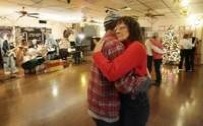

Bill Sniegowski and Barb Thrall enjoy a dance at Moose Lodge 713 in Toledo. (THE BLADE/ANDY MORRISON)