
BY RYAN E. SMITH
BLADE STAFF WRITER
When Roger LaPointe talks about the importance of working out your whole body, he means it.
Just look around the Bowling Green warehouse of his business, Atomic Athletic, Inc. It’s filled with dumbbells, thick climbing ropes, and a poster of a man lifting a 300-pound anvil with his beard.
OK, that last one might be taking things a little far, but Mr. LaPointe’s style definitely hearkens back to the days of the old-time strongman, when functional strength was prized over bulging muscles just for show. He surrounds himself with pieces of equipment that haven’t been en vogue in this country for many decades or, in some cases, ever.
“I’m a student of history,” says Mr. La Pointe, 37. “I can get a historical appreciation of what these other people did. It’s also fun and there’s a real challenge to it.”
The floor around him is littered with granite spheres weighing up to 244 pounds, the kind people today might recognize from the World’s Strongest Man competition but which go back thousands of years. Mr. LaPointe has wooden clubs from India, kettlebells that look like cannonballs with handles, and jade padlocks — think thick bricks with handles — used by Chinese Shaolin monks.
These and other traditional strength training tools will be on display Saturday at the Atomic Athletic Great Black Swamp Olde Time Strongman Picnic. If the stone lifting and other contests don’t impress you, maybe seeing a man juggle barbells or roll up a frying pan with his bare hands will. The free event takes place from 1 to 6 p.m. at 500 Lehman Avenue in Bowling Green.

The thing about strongmen who performed a century ago as part of circuses or vaudeville acts is that they weren’t just working out to look buff like today’s bodybuilders, according to aficionados.
“The old-time weightlifters, their focus was not just on being strong but on being physically fit and being healthy,” says Al Myers, vice president of the United States All-Round Weightlifting Association, a group formed to preserve the kinds of lifting done long ago. “Today’s generation, it’s all about strength.”
So modern gym rats sit at a machine and do the same exercise over and over, working one muscle at a time. That doesn’t happen when you’re swinging around a 35-pound, 3-foot-long wooden club or doing exercises with a perfectly round rock; you work multiple muscle groups and force them to work in harmony.
“Lifting a 75-pound barbell is one thing; lifting a 75-pound stone is more akin to wrestling a grizzly bear. It’s trying to come out of your hand all the time,” explains Aaron Hillmann, director of strength and conditioning for Bowling Green State University, which has about 10 stone balls weighing between 15 and 140 pounds.
Aside from encouraging mental and physical toughness, Mr. Hillmann says the use of such equipment engages his athletes “from the neck up. ... It’s not the same old stuff every single day.”
Others are noticing too. Traditional strength training tools now make up about 25 percent of the fitness equipment sold by Atomic Athletic, and in December Men’s Health magazine included the company’s jade padlocks in its holiday gift guide. Mr. LaPointe says that past customers include the Cincinnati Bengals, Cirque du Soleil, and the University of Michigan.
Todd Baden, owner of Synergy Sports and Performance in Sylvania Township, says that while going retro may still be a niche, using things like Indian clubs can help the entire body by providing a great variety of exercises and improve range of motion.
“You’re teaching the whole body to work as one,” he says. “That’s kind of the beauty of doing the old-style training.”
Some of these items, according to Mr. LaPointe, have become available in America because he rediscovered using them for fitness — often through old photos and martial arts and military manuals — and started selling them through his business.
“I’ll study stuff in books and videos and I’ll get things from Asia and the Middle East and just hunt it down just like any other researcher would do,” says Mr. LaPointe.
The Walled Lake, Mich., native who stands 5 feet, 3 inches tall got his start in weightlifting during junior high school using his great-grandfather’s set of barbells. Even though Mr. LaPointe’s academic studies focused elsewhere — he has a master’s degree in political management from George Washington University — his passion for Olympic-style weightlifting eventually led him into the business, and things have expanded from there.
One of his newer items is called the stone wheel. It looks like a giant, granite doughnut that you put around your neck and easily could be mistaken for a torture device, weighing in at between 20 and 90 pounds.
Mr. LaPointe got the idea from an old Indian training manual that had pictures in it. He wears them while doing squats and other exercises but says that manual has additional suggestions that leave no doubt as to the toughness of its original users.
“The first line in that course is: Put your stone wheel on. Jog a mile.”
Originally published in The Blade on Sunday, May 10, 2009
Old-fashioned equipment builds men who can juggle barbells

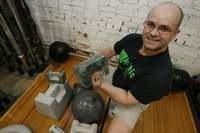

Mr. LaPointe exercises like an old-time strongman. (THE BLADE/JETTA FRASER)