
BY RYAN E. SMITH
BLADE STAFF WRITER
Take your normal level of excitement about arithmetic and multiply it by two. Then double it again.
Now you're getting into the spirit of World Math Day.
The fourth annual event taking place today is expected to involve more than 2.5 million students from 40,000 schools across the globe in online math activities. Part of its purpose is simple: Make math fun.
"That's my mission," said Scott Flansburg, author of Math Magic for Kids and global ambassador for the event, which was created by the company 3P Learning.
Don't laugh. Known as the Human Calculator for his ability to add numbers in his head faster than someone can punch them into a calculator, Mr. Flansburg is passionate about curbing innumeracy, or mathematical illiteracy.
"World Math Day is a day that will help children recognize the importance of math," he said.
At Holloway Elementary School in Springfield Township, Terri Schultz's second graders will take part in the worldwide event as a way to learn that numbers are a global language.
"It's something new, something different, something to make math interesting," she said.
Attempts at making math seem cool are not new. The CBS hit Numb3rs is about a mathematical genius who helps solve crimes, and Lindsay Lohan was a mathlete in Mean Girls. Actress Danica McKellar - Winnie from The Wonder Years - grew up to be a real-life math goddess who wrote Math Doesn't Suck.
In the classroom, though, it's not always so easy for math teachers to hold kids' interest.
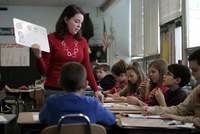
"It's hard to do," admitted Amy Boros, a fifth-grade math teacher at Frank Elementary School in Perrysburg.
But it's not impossible. Her students this year learned fractions while doubling and tripling recipes for cookbooks they made, and they incorporated word problems into children's books that they wrote. They studied geometry using amusement park models that they built and keep their basic skills fresh through daily dice and card games.
"Some people call me the Little Vegas," Mrs Boros said. "My goal is to make it fun and real world and realistic so that they have a reason for doing it."
According to students like Hannah Parks, 10, it appears to be working. She loved using her art skills for the amusement park project.
"It made me realize that math is more fun than I expected," she said.
At Sylvania's Hill View Elementary School, students are gearing up for the Metric Olympics on Friday. Events will require the students, along with their peers from Whiteford Elementary, to use the metric system to estimate and then precisely measure how far they can toss a paper plate (discus) and throw a paper straw (javelin). Other contests involve the weight of marbles they can pick up with one hand and the amount of water they can squeeze out of a sponge.
"I just think that they really get a hands-on experience of math and how it relates to their world in a fun way," principal Adam Fineske said of the event, now in its second year. "They learn a lot from it."
They'd better, because much is at stake.
"Science and math really define our lives in very sophisticated ways. That's only going to get bigger and more profound for kids," said Michael Lach, special assistant for science, technology, engineering, and math education at the U.S. Department of Education. "This is where the next generation of inventors and designers and creators is going to come from."
Internationally, America's performance has improved slightly in math but remains in the middle of the pack, he said. The most recent Trends in International Mathematics and Science Study in 2007 showed U.S. eighth-graders to be behind peers in Japan and Singapore, but about equal to those in England and the Russian Federation.
While Mr. Lach said there are no easy fixes - he spoke of holding students to high standards and making sure that teachers really know their stuff - less traditional means can help.
"We know that for many, many kids, it's actually the out-of-school experiences that get them excited about becoming a mathematician or a scientist," he said. "It's a trip to a museum. It's doing a science fair project."
It's in that spirit that East Broadway Middle School in Toledo had a math carnival night last month.
"We had over 200 people come in to play math games," said Heidi Sitzenstock, math department chairman. "They've gotten very dependent on calculators. We're just trying to reinforce mental math."
No one is expecting this generation of kids to grow up into adults who do their taxes in their heads, but it would be nice if businessmen didn't have to reach for a calculator during a meeting to do simple arithmetic. So educators keep looking for ways to make math fun, whether it's through holding a Pi Day celebration on March 14 in honor of the mathematical constant pi (3.14...) or considering a kit put out by Rubik's Cube meant to get kids engaged in the math.
These efforts may get a lot of attention, but the broader curriculum has been undergoing significant change too, from one based on memorization and procedure to one meant to be more engaging based on understanding the concepts behind the math, said Susan MacMillan, director of math and gifted education for Toledo Public Schools. That means more hand-on activities and working in groups, and it can be so different from the past that some schools in the district, like Lagrange Elementary School, offer Parent Math Day to show parents how it all works now.
"One of the things that we really need to do is develop that flexible thinking and the fluidity so kids don't just learn [facts] but learn how to use them," Ms. MacMillan said. "We want silver bullets. We want a quick fix, but there just isn't one to replace deep, conceptual understanding."
Originally published in The Blade on Wednesday, March 3, 2010


World Math Day adds up to fun for students and parents
Amy Boros uses cutouts to teach her fifth-grade math students at Frank Elementary School in Perrysburg. (THE BLADE/ANDY MORRISON)