
BY RYAN E. SMITH
BLADE STAFF WRITER
BLADE STAFF WRITER
Andrew "Bud" Fisher could tell you all about what it was like for the veterans who lived through World War II. He's interviewed hundreds of them.
But the Sylvania man won't tell you. He'd rather let them.
The result is What a Time It Was: Interviews with Northwest Ohio Veterans of World War II, published by the University of Toledo Urban Affairs Center Press. The book focuses on 80 people and contains question-and-answer selections from Mr. Fisher's conversations with military personnel and others that took place as part of his volunteer efforts with the Library of Congress' Veterans History Project, a national effort to preserve these stories for future generations.
Edited and compiled by Mr. Fisher, 78, the book will debut today in conjunction with a ceremony at UT to dedicate its Veterans' Plaza between University Hall and Memorial Field House. That event at 11 a.m. - the same time World War I fighting between the Allies and Germany ended on Nov. 11, 1918 - will be followed by a book signing.
Mr. Fisher, a veteran who was stationed in Europe during the Korean War, got involved in the Veterans History Project in 2002. He said it's important to tell the stories of these modest men and women.
"In past wars, we heard of no one but the generals. We know about Patton and we know about Eisenhower and Bradley and Nimitz," he said. "But never before have we listened to the guy in the trenches."
Just as important, he said, is how you do it. The book shows the details of war, with all its humanity and all its searing pain, through the veterans' own words. Even reading just one interview provides a better understanding of war's true nature.
"It's not John Wayne," Mr. Fisher said. "[Readers] will learn that the veterans were scared. They'll learn that they were tired and dirty and slept in a water-filled foxhole."
Consider the experience of Donald W. Applegate, who received the Distinguished Service Cross and the Silver Star. Not only did he have to contend with superior German firepower in Europe, but he speaks in the book about the crushing cold as well:
"It was below zero and we were sleeping on the ground or in cellars. ... Our combat boots were porous and the number of men lost to frostbite and trenchfoot was enormous and we had to wear our overcoats in combat."
Now 87 and living in Sylvania Township, Mr. Applegate said these tales are more than just nostalgia.
"Those experiences are in a sense kind of universal," he said.
Mr. Applegate expects to be at today's dedication ceremony at UT, where locally recorded interviews conducted as part of the Veterans History Project are archived. (Copies also are given to the veterans and sent to Washington.)
Don Clees, 84, of South Toledo, expects to be at the event too. He was a B-29 bomber crew member in the Pacific Theater. In the book, he recounts a couple of harrowing encounters, including once when the bombs in the rear bomb bay got stuck:
"The right gunner and I went crawling out along the catwalk, without parachutes, while holding on with one hand and working to loosen the bombs with the other. All the while the smoke rising up from Tokyo was blinding us and choking us. When the bombs finally broke loose, I was swung around like a maypole over the open bomb bay. The gunner grabbed me and pulled me back to safety."
Mr. Clees said he is glad he took part in the interview.
"Now we have something for the kids to pass down," he said.
What a Time It Was will be sold at the UT Bookstore and online at tiny.cc/Lp4oe.
Originally published in The Blade on Wednesday, November 11, 2009
Veterans share stories of World War II

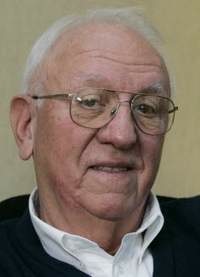

Bud Fisher, editor of ‘What a Time It Was’ (THE BLADE/LORI KING)