BY RYAN E. SMITH
BLADE STAFF WRITER
Bill Kitson has a lot to be proud of when he gives tours of the new downtown headquarters of the United Way of Greater Toledo, but one part stands out as his favorite: the urinals.
"I love to show it on the tour," the group's president said.
After all, they're waterless. No muss, no flush.
They're also more interesting proof of the building's efforts to save energy than, say, an efficient air-conditioning unit.
"These are kind of space age," Mr. Kitson said.
The receptacles - in this case, tube shaped — are increasingly popping up in public restrooms, from Citi Field, home of the New York Mets, to the Lucas County Arena, home of the Toledo Walleye. It's been an uphill climb, though, and not just because some are located at Pike's Peak in Colorado.
"It was certainly very, very, very tough," said Klaus Reichardt, founder of Waterless Company in California. He patented modern waterless urinal technology, based on a Swiss idea from the late 1800s that never caught on, about 10 years ago during a major drought.
Even though he said no-flush urinals are more sanitary, conserve water, and avoid other problems, consumers couldn't get over the "ugh" factor at first. Now more seem to be coming around, spurred by the 20,000 to 45,000 gallons of water that can be saved by each urinal every year.
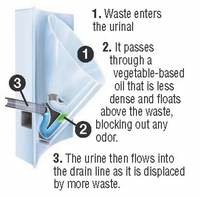
The way they work is simple. At the arena in downtown Toledo, the waterless urinals by Kohler rely upon a vegetable-based oil that is poured inside. (Some manufacturers use a removable cartridge.) The liquid is less dense than urine, allowing the waste to pass through. The oil then floats on top of it, acting as a seal against odor, according to Mark Mahoney, a spokesman for Kohler. The waste enters the drain line from there.
Giggle if you must, but waterless urinals have become no laughing matter.
"They're being really well received," said Marie Coleman, communications associate for the U.S. Green Building Council. "Waterless urinals are a great way to save on your water reduction strategy, not only just because of the water savings and therefore some of the cost savings associated with that, but also just sanitation."
As with any product, different models are better than others and they require different maintenance. Larry Friedman, president of the cleaning company Toledo Building Services, said the technology seems to be getting better.
"I think the newer ones have a better design so there's less smell," he said.
Steve Miller, general manager of SMG, the firm that runs the Lucas County Arena, hasn't noticed any problems so far.
"I don't think there's much difference at all, frankly," he said "I know people have had no issues using them."
Some guys may be baffled for a moment and stand wondering: how does it flush? But then the moment passes.
Still, Mr. Reichardt said, a heads-up to new users or employees couldn't hurt and might even contribute to a more positive attitude.
"Maybe instead of complaining Monday morning, they're waiting Monday morning to be the first to take a leak."
Originally published in The Blade on Sunday, November 1, 2009
2 new downtown Toledo sites install waterless urinals