Originally published in The Blade on Sunday, January 27, 2008
BY RYAN E. SMITH
BLADE STAFF WRITER
It is 8 a.m. and there’s a jailbreak at Clay High School in Oregon.
Students are scattering, receding to every corner of the room, crawling under computer tables. But they’re not the ones being chased. The escapees are six young parakeets enjoying some freedom from their cages in Linda Rossler’s agricultural science classroom.
They’re here to be tamed, but that may be hard to tell as they flit all over the room, bobbing behind furniture or testing their wings to avoid being corralled by a bunch of
freshmen.
“When you have lots of birds with lots of students, you have pandemonium,” says Dr. Susan Orosz, the local veterinarian who helped create this spectacle.
Three years ago, Dr. Orosz, whose daughter is a senior at Clay, helped arrange a partnership between the school and Pet Supplies Plus. The goal was to take
young parakeets that arrive at the store feeling wild and afraid and make them comfortable around humans, more likely to step up on a finger than to bite it. Then they would be returned to the store and sold, and hopefully have a better quality of life.
Students like Kirsten McLaughlin, 15, are encouraged to handle the birds and calm them — if they can catch them. Right now, she’s busy chasing an electric-blue parakeet that keeps scurrying under a cage.
“How dare you!” she scolds. “He’s nimble.”
Across the classroom is a stark contrast. There, Dan Niezgoda, 16, has a parakeet sitting completely still on his finger.
“I’m the bird whisperer,” he jokes. “I found a bird that likes me. I just don’t want him pooping on me.”

For the students, who find time with the birds before or after school, during study hall, and sometimes in class, it’s a valuable opportunity to handle avian creatures and to bond with them. The parakeets usually arrive when they’re only 6 to 8 weeks old.
“It’s an awesome experience, especially for a kid [who] wants to be a veterinary technician or veterinarian,” says Mrs. Rossler, the teacher.
Her classroom also includes a couple of larger birds that the pet store allows the students to work with: an Eclectus parrot with behavior problems and an African gray parrot that had almost plucked itself bald.
Dr. Orosz, a former professor at the University of Tennessee who owns Bird and Exotic Pet Wellness Center in West Toledo, says the partnership provides a good learning experience for kids who are used to interacting with other types of animals.
“They’re learning birds are birds and they’re not dogs and cats, that you can’t pet them like you can a dog or a cat,” she says. “I think it’s a great stepping stone for these students.”
These types of programs are not common but definitely are important, for the benefits they provide to the students as well as the birds, according to Dr. Scott Echols, of Austin, president of the Association of Avian Veterinarians.
“I think that it gives the kids a better understanding of animals. ... It allows the animals to better interact with people and be a better pet, more or less,” he said. “[Dr. Orosz] is definitely one of the group of leaders that’s really doing new and innovative things.”
Dr. Orosz is a Woodward High School graduate who is past president of the Association of Avian Veterinarians. She was honored last year for her accomplishments with what Dr. Echols called the highest current honor in avian medicine, the Dr. T.J. Lafeber Avian Practitioner Award.
Dr. Orosz said the program at Clay was inspired by the work of Dr. Lafeber, her mentor, who was known to engineer similar parakeet pandemonium with his students. The bird food business he started, Lafeber Company, helps provide food for the birds at Clay, as does Pet Supplies Plus.
So far everyone involved in the program seems to be benefiting, including the local pet store. The Talmadge Road location, which sells the birds at a $10 mark-up after the high school students have worked with them for a month or so, has a waiting list of customers interested in the tamed parakeets.
“People are definitely more interested in purchasing something that’s trained and is not going to be biting their little ones’ fingers,” explained Mandi Simons, head of customer service at the store. “They do a good job over there. They come back a completely different bird.”
The birds are just as popular with many of the students, who tolerate their biting in the hopes that they’ll make a great pet one day soon.
[We’re] teaching them so they behave for other people,” said Daniel Mausser, 14. “Once they calm down, they’re fine.”

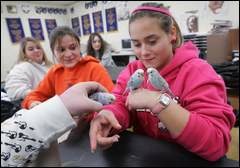
Jessica Rawlings is handed a third parakeet in a class at Clay High School. (THE BLADE/LORI KING)
Clay students ready birds for pethood