
Originally published in The Blade on Sunday, January 20, 2008
BY TAHREE LANE and RYAN E. SMITH
BLADE STAFF WRITERS
A penny.
It seems almost ridiculous to imagine that a city could be graced with art, one penny at a time.
But Toledo's 30-year-old One Percent for Art program, which sets aside one cent for each buck the city spends on construction, is an exemplary lesson in economies of scale.
Since 1977, when Toledo became the first Ohio city to embrace a national trend of earmarking public dollars for city art, about $3.5 million in local tax dollars and $1.2 million in private and other funding have enhanced the urban landscape with 47 sculptures and murals.
"It's a great thing that City Council did," says Susan Reams, who introduced the ordinance establishing the program in 1977, and has worked tirelessly for it ever since. "The arts are all about quality of life."
On March 4, Toledoans will be asked to renew the 0.75 percent temporary income tax, which, if passed, will increase the budget for public art for the first time in four years.
Like apple pie and motherhood, it's nigh on to impossible to find a detractor of the program that has spread beauty to city parks and concrete parking structures, library grounds, ballparks, train and fire stations. Its fruits include the wavy white entrance to Ottawa Park on Bancroft Street, the curvilinear fountain at the foot of Harvard Boulevard, and five life-sized bronze statues of a young family in downtown's Promenade Park.
But much has changed since the birth of this pioneering initiative: sculpture materials and art are more expensive, the program's job description has expanded, and there's less money for it.
"A $25,000 sculpture would have gotten you something nice in 1977," says Marc Folk, executive director of the Arts Commission of Greater Toledo, which oversees the program. "Now, a sculpture would cost a couple hundred thousand dollars."
One Percent for Art also rocks and rolls with the vagaries of the city budget.
There are other pressures too.
After you build a collection, you have to maintain it. Weather, animals, and people damage outdoor art, and repairs and replacement are expensive. Taking care of the dozens of pieces installed since the fiery bolt that is Major Ritual became the first permanent purchase in 1979, consumes a third of the annual budget. This year, three large sculptures will be repainted at a cost of $56,000.
Moreover, the city has bestowed on the One Percent for Art program the task of looking after nine of its pieces, including the 121-year-old bronze of Toledo Civil War hero Gen. James Steedman in Jamie Farr (Riverside) Park and Woman with the Birds by the late Toledoan Joe Ann Cousino in Toledo Botanical Garden.
The program also takes care of 71 small objects in a collection called "art in public buildings," many of which were purchased as contest awards for the Toledo Area Artists' Exhibition and other art shows.

And it does education and outreach, including partial support of the Young Artists at Work summer program that employs teens. An audio sculpture tour of the city, downloadable from the Internet to MP3 players, is expected to be available by mid-summer.
Seed money
Toledo's One Percent for Art budget is far smaller than average among 350 such programs across the country. According to a 2001 survey (the most recent to date) by the non profit advocate group Americans for the Arts, the average city's public art budget was $779,968.
In 2007, Toledo's One Percent budget was $202,200; its largest-ever budget was $278,365 in 2001, and its smallest was $150,272 in 2005. (The 2008 budget will be set in March.)
Consequently, the program doesn't buy much art anymore.
"It's used as a leveraging tool," says Adam Russell, the program's coordinator and sole employee.
Instead of purchasing sculptures and murals, the program has been reshaped to fit its bigger responsibilities and smaller budgets. It "seeds" the acquisition process, spending money to select a pool of potential artists for a project and launching a fund-raising campaign to get the piece built.
"There's much greater involvement of the private sector," adds Mr. Folk.
Consider the dramatic piece being made by a California artist for the under-construction downtown arena: a twisting 27-foot-tall keyboard lit from within that will be a paean to Toledo jazz pianist Art Tatum.
The One Percent for Art program spent $50,000 on the design competition (which included modest payments to each finalist for their developed projects and presentations to the selection committee). A private firm will run a campaign to raise $300,000 for the sculpture that will enliven the arena's Superior Street entrance.
A memorial tribute to the people who worked on the Veterans' Glass City Skyway (art is expected to be completed in 2010), budgeted at about $125,000, will be paid for with private funds and built, in part, with donated union labor.
After a 30-inch bronze statue of early golf and park advocate Sylvanus P. Jermain was stolen last summer from the rock on which it had stood since 1928, Robert Reifert, a former Toledo businessman, donned waders and searched the golf-course pond for it in vain.
Mr. Reifert, an avid golfer who lives in Florida and returns to town periodically, pledged to organize golf outings to raise $11,000 to create a replica.
Susan Reams, a staunch believer that collaboration breeds synergy, worked to get four pieces of art at Fifth Third Field that were private-public ventures. She notes that the sons of the late White Family Co. car dealer Jim White, Sr., donated I've Got It!, an inside-the-stadium bronze of three boys poised to catch a fly ball.
The field's striking main-entry gates feature six gargantuan wooden baseball bats and bronze mitts, paid for by Lucas County. The city's One Percent program paid for the 22 baseball-themed manhole covers outside the field. And Emanuel Enriquez's endearing Who's Up? of four bronze kids peeking through knotholes in the fence along North St. Clair Street was paid for by a mix of One Percent, county, and private funds.
"That's really how things get done," she says of partnerships. "You don't just ask people for money, you match money."
High visibility
Art in high-profile, urban locations softens hard edges and refreshes the soul. It can create a gathering place, a conversation piece. The notion prevailed in ancient Greece and Rome and even earlier, in the time of idol-carving and cave-painting.
Philadelphia led the country with its percent for art program in 1959 and other cities followed suit, particularly after the National Endowment for the Arts, created in 1965, promoted its Art in Public Places program.
Mrs. Reams, appointed in 1974 to the Arts Commission of Greater Toledo, was asked by the commission's director to explore the possibility of a One Percent for Art program here. She ran with it, finding a model in Seattle.

Still successful, Seattle has nearly 450 permanent and 3,000 portable pieces and revenue of just over $3 million last year for its program. The biggest hurdle it has faced was a lawsuit filed in 2002 that unsuccessfully challenged whether ratepayer funds from the city-owned electric utility could be used for the art-funding program.
"The lawsuit questioned the use of utility dollars for public art. If it was upheld, it could have been viewed as a significant precedent," explained Lori Patrick, spokesman for the Mayor's Office of Arts and Cultural Affairs in Seattle.
Nationwide, about 350 such programs spend $150 million a year, according to Americans for the Arts. In addition to culling one percent from a city or county's construction budget, some municipalities derive money from dedicated bond revenues or hotel taxes. It's an upward trend, particularly in growth areas such as Florida, notes Liesel Fenner of the Americans for the Arts.
"I think it's the rise in basic real estate development and the fact that art is seen as an enhancement in furthering the sense of identity of a place, or a new town, or a new civic square. It improves civic design exponentially."
Jack Becker, executive director of Forecast Public Artworks, a St. Paul-based nonprofit that publishes Public Art Review semi-annually, says the arts can be a tough sell in terms of quantifiable impact. But there are plenty of wonderful intangibles: "Businesses attract employees, communities building a sense of pride, for neighborhoods to establish an identity that's distinct from the next neighborhood, for cities to declare their uniqueness, for communities to garner media attention that they might not garner otherwise," Mr. Becker says.
Moreover, it's a boon for artists.
"More and more artists, I believe ... are gravitating to public art," says Mr. Becker. "It's probably because of the visibility it affords their work. ... With that is the opportunity for, and in some cases the mandate to, have a dialogue with the public."
Passion for the arts
In what has to be the envy of most cities, a couple of highly interactive pieces draw steady throngs to downtown Chicago's Millennium Park along Michigan Avenue.
Cloud Gate (2005), nicknamed The Bean, is a gleaming 33-foot-tall, 66-foot-long steel structure shaped like a drop of bouncing mercury. The nearby Crown Fountain (2004) boasts a pair of 50-foot-tall, glass-block rectangles displaying slow-motion videos of Chicagoans' faces, and spurting streams of water from their pursed lips.
Both quickly became signature pieces for Chicago. They are thought to have positive economic impact and have become a magnet drawing people to the park. However, they weren't cheap, costing $23 million and $17 million respectively, paid for by private donations.
But public money often is scarce. Consider Michigan's tough situation. It gave up its statewide art in public places program more than 15 years ago because of budget cuts.
"We just ran out of staff and money," explained John Bracey, executive director of the Michigan Council for Arts and Cultural Affairs. "It's been tough economic times."
And in Columbus, where recent efforts to start a program keep getting stalled, the hurdle continues to be: Why should we spend that kind of money on art? says Wayne Lawson, director emeritus of the Ohio Arts Council, which manages the state's One Percent program that was modeled after Toledo's.
"You've got to have some really big advocates to get that passed," Mr. Lawson explains.
More than anyone, Toledo's advocate has been Mrs. Reams. In April, she'll be honored by Gov. Ted Strickland as Ohio's art patron of the year, for more than 30 years of indefatigable work, mostly as a volunteer.
Her success has been because of a contagious passion for art, the vigor to carry on gamely even when she doesn't get her way, and tireless fund-raising.
Fifteen years after lobbying City Council to approve the original ordinance, she and the arts commission returned to request it be changed.
Until then, money set aside from each construction job resulted in art being situated at that site, which sounded reasonable until you consider how many people would go to a city water department building to see it.
More importantly, the approved changes allowed funds to be aggregated over time. And, goals were set, such as establishing "gateway" art for the city's neighborhoods.
The chronic challenge remains money. The program took a hit after 2004 when voters approved an extension of the 0.75-percent temporary income tax that changed the formula to let capital-improvements money be diverted for other uses, decreasing the amount available for art. The result? In the last three years, $100,000 was spent on things other than art, says John Sherburne, the city's finance director.
On March 4, the tax renewal again will be on the ballot, but this time, the formula will revert to its pre-2004 status. That will mean more for art, says Mr. Sherburne.
Despite Toledo's bleak financial forecast, there's no talk of scaling back the One Percent for Art program, according to George Sarantou, chairman of city council's finance and budget committee.
"I think it's an excellent program," he says. "It's a worthwhile investment."
And the payoff, Mr. Lawson likes to say, is to everyone.
"It's for the public, it's not for the few," he says. "Everybody's equal when they walk up to a piece of public art."

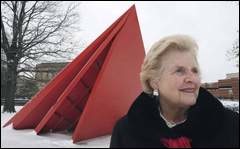
Susan Reams, who helped establish Toledo's One Percent for Art program, stands in Civic Center Mall with "Major Ritual." (THE BLADE/JEREMY WADSWORTH)
MULTIMEDIA
Public art effort expands as Toledo program takes on change in 30th year

PUBLIC ART ODDITIES
When nesting geese, kids with skateboards, and pranksters armed with soap jugs interact with art, there are consequences. Here are some of the more unusual stories behind Toledo's public art.
ONE PERCENT FOR GEESE
The floating sculptures Watching for the Wind (1989) are serene images on Crosby Lake at Toledo Botanical Garden. Resident fowl, however, discovered a practical use for them: the foam on which the structures were built was dandy nesting material for cradling eggs and goslings. But one peck too many and the pieces sank, forcing humans to fish for art. The three pieces were rebuilt with aluminum pontoons.
INSPIRATION AS RECREATION
The Kabuki Dancer (1984) in downtown's Levis Park was a siren song luring skateboarders whose antics caused seams on the aluminum sculpture to separate. And if that weren't enough abuse, a nearby apartment dweller is believed to have used it for target practice from his or her room, shooting off quarter-sized chunks of paint. It's being repaired and upon return will sit on grass, hopefully, out of gun-sight of the apartments.
FORE GONE
A 32-inch cast bronze statue of golfer and park advocate Sylvanus P. Jermain was stolen last year from Ottawa Park where it had been since 1928. It's thought to have been sold for scrap. A new statue is being made based on photos by Ohioan Brian Maughan.
TOLEDO SOUVENIRS
Baby fingers, sandal straps, and bottle caps have been snatched so often from Family (1984), five life-sized figures in Promenade Park, that the Arts Commission of Greater Toledo keeps a box of spare parts.
FOAMING FOUNTAIN
Plastic detergent jugs often are fished out of the pool at the foot of Three Clouds Harvard Circle Fountain (2000), a fountain in the traffic circle near Walbridge Park in South Toledo. Residents of the neighborhood are used to seeing the fountain roiling with bubbles.
ONE PERCENT'S EVOLUTION
1977: Toledo City Council passes an ordinance calling for at least one penny of every dollar spent on city construction/renovation projects to be used for art at the site of the construction.
1979: Beverly Pepper's Major Ritual, the first permanent piece commissioned by the program, is installed on Civic Center Mall downtown. A mix of city and private money paid its $68,000 cost.
1990: Toledo's ordinance is used as a model by the Ohio Arts Council for the state's one percent for art program.
1992: City Council corrects some problems with the 1977 ordinance, allowing money to be pooled from multiple construction projects, and for art to be installed at locations other than the construction site.
2001: The program's peak funding year: $278,365.
2004: A change in the city's 0.75 percent temporary income tax formula causes $100,000 to be diverted from the One Percent for Art program to other city services over four years.
2005: The program's lowest funding year (since the revisions of 1992): $150,272.
2008: Voters will be asked to renew the 0.75 percent temporary tax March 4. If approved, arts funding will be restored to pre-2005 levels.