Originally published in The Blade on Sunday, March 2, 2008
BY RYAN E. SMITH
BLADE STAFF WRITER
WAUSEON — This is a story of a big family that kept getting bigger.
It started, of course, with a baby. Nine more followed, and so did the wide-eyed stares of people watching the happy brood of Pat and Jim Dominique.
Ten kids were just the beginning for this Catholic family. Things really got going once the family moved out of its three-bedroom ranch home here — the six girls sleeping in one room, the four boys in the other — and into a place with two more bedrooms.
“We thought, man, we’ve got all this room now!” remembered Mrs. Dominique.
So they added more members to the family, acting as foster parents to more than 100 children over the years and adopting 14.
“Kids are our vocation,” said Mrs. Dominique, 70. “That’s been our life for 50 years.”
Today, the couple boast 24 children, ranging in age from 4 to 52.
Family gatherings at Christmas time or Thanksgiving can draw more than 70 people when you add in spouses, grandchildren, and great-grandchildren.
It’s more than most people can handle.
To help, Mrs. Dominque keeps a little cheat sheet (if a four-page list of names and birthdays can be considered little).
“You know, when you are 70 and have that many to keep track of you need to write it down to make sure you haven’t missed one or two,” she said.
Big families like this are often seen as novelties these days, reality show curiosities that have “living large” down to a science on programs like The Learning Channel’s Kids by the Dozen. For parents of just one or two children — the average number of children born per woman in the U.S. is two, according to the National Center for Health Statistics — it’s a different world.
Meagan Francis, a Michigan native who wrote the book Table for Eight: Raising a Large Family in a Small-Family World, said modern parenting practices that demand more of everything — time, money, etc. — have led to an increasing gulf between small families and one like the Dominiques.
“Once you’ve already got 10 kids, you’ve already kind of stepped over the line as far as most people are concerned,” she said. “People now will literally look at my family of four kids and they actually can’t understand how I can do it. It’s not a rhetorical question.”
Which raises the question: How did the Dominques do it?
A station wagon (and no worries about everyone wearing seat belts) helped. There were some other practical considerations too: When they were little, the kids all shared one glass for milk at meals to avoid spills. They all helped out around the house, and Mrs. Dominique learned how to make their clothes. The family also found an inexpensive form of recreation in frequent camping trips.
And then, of course, there were the dinner dates — just for the adults.
"We went out to eat twice a week, just for my sanity," Mrs. Dominique said.
Rooted in their faith, the family never had a lot of money but considered themselves rich in other ways. When they got a bigger house and read a newspaper story about the needs of local foster children, they decided to spread the love.
"We wanted to be able to help a lot of kids," said Mr. Dominque, 73, a retired remodeling contractor who grew up with seven siblings and always wanted a big family of his own.
Over the years, the Dominiques took in kids who had endured all manner of sexual and physical abuse and neglect. They adopted across racial lines, too.
Having a big family already actually made these difficult cases easier, explained Laura Draheim, coordinator for the placement department in Lucas County Children Services, who worked with the family over the years.
"Because they have such a large family - birth children and adopted children - they just sort of envelop someone when they go into the family," she said.
This is not to say that everything worked out perfectly. One adopted child was arrested for stealing a car and another just calls to ask for money. They have lost touch with a couple but hope that their time together taught the kids an important lesson about family love.
"Mom and Dad had a basic motto of: You can go ahead and run away, but we'll prove to you that we love you," said daughter Jodi Richardson, 38, of Napoleon.
The youngest of the Dominique's biological children, she remembers fondly what it was like growing up in a household that at times had 16 kids living under the same roof.
"We tended to be our own best friends," she said. "We didn't have a lot of outside friends because you didn't really need them."
As parents, the Dominiques were strict but loving, she said, and they cherish the fact that many of their kids have gone on to managerial positions professionally. (A few have also gone on to become foster and adoptive parents themselves.)
Michelle Gigax, 35, of Wauseon, who was taken in by the family when she was 13 and adopted at age 16, said it seemed there never was a situation for which they were unprepared.
"You could tell that they had dealt with it before," she said. "They knew exactly how to handle everything."
"My mom and dad are either saints or insane, and I'm not sure which," she said.
Some of the kids were surprised when their aging parents adopted a toddler. But in a way, it made sense, too.
"This is what keeps them alive," Mrs. Richardson said. "This is what they love and what keeps them young. They're not just doing it for the kids. They're doing it for themselves."
Mrs. Richardson, who has five children of her own, said she learned from their example and wanted to start her own big family. Just not quite as big.
"[Five] was our happy medium," she said. "I see what my mom saw all those years as she kept adding and adding. I just want to keep some degree of sanity."

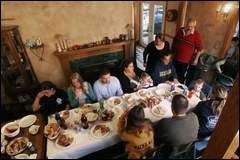
Some of the members of Pat and Jim Dominique's family, made up of 10 biological and 14 adopted children, gathered around the table for dinner.
(BLADE PHOTOS/AMY E. VOIGT)
Wauseon couple have 24 children, ages 4 to 52