
BY RYAN E. SMITH
BLADE STAFF WRITER
Paul Medlen wakes up every morning with more than 68 bits of metal sprinkled throughout his body. He can feel them as he runs his fingers over his wrist and up his arm. He can see them dotting his face and chest on X-rays.
Every morning, he wakes up with them and faces the question: How do you put your life back together when so many of the pieces that broke it are still trapped inside you?
"It never gets any easier, but it becomes a way of life," the East Toledoan says. "That's the skinny on it."
It's been just over five years since those bits of metal became forever intertwined with Mr. Medlen's body and this city's soul. That's when a Jeep body shop worker with deadly intentions entered Chrysler's Toledo North Assembly plant with a shotgun on Jan. 26, 2005, wounding two and killing a supervisor and himself.
The tragedy led to numerous lawsuits against the automaker's former owner and its security firm, some of which remain pending, and it still is too painful or too embroiled in the courts for some people who were involved to speak.
The family of Roy "Tom" Thacker, the supervisor who was killed, and Michael Toney, the other wounded man, declined to be interviewed for this story through attorneys.
Mr. Medlen admits that the day Myles Meyers shot him from about 30 feet away is one that he thinks about daily, whether it's when he gets up and sees the scar on his abdomen or when he walks through the turnstiles at the Chrysler plant, where he has returned to work.
For him, the memory begins with a scream. It was after 8:30 p.m. during second shift, and he was putting hoods on vehicles.
"I heard a hellacious cry on the radio," remembers Mr. Medlen, 46. "It was something like you'd hear in a horror movie but worse."
It probably came from Yiesha Martin, an employee who was confronted by Mr. Meyers after he entered the plant with a 20-gauge double-barreled shotgun hidden under his jacket, secured with wire and tape.
Through her attorney, Ms. Martin declined to be interviewed for this story because she is part of a lawsuit that has not been resolved.
Mr. Meyers, 54, had not reported to the start of his shift after a meeting the day before that involved issues with his job performance. He pointed his gun at Ms. Martin and named a list of people he was going to kill. The gunman demanded that she call to the office Mr. Toney, who arrived behind Mr. Thacker. Both were on Mr. Meyers' list, along with a woman. Mr. Meyers fatally shot Mr. Thacker in the chest, then fired and hit Mr. Toney in the right arm.
'This is how it ends'
Soon after the initial shootings, Mr. Meyers crossed paths with Mr. Medlen, his team leader, who says he didn't know about the shots fired and feared there may have been a workplace accident. Mr. Medlen greeted his co-worker, not seeing the weapon, and was shot in the left side. Shotgun pellets embedded from his head to his thigh and lodged in numerous organs.
"I went down, and I got right back up, and I took off running," he says.
Mr. Meyers went back to the office and shot himself while Mr. Medlen lay about 100 feet from where he was struck, wet with blood. His left side was numb and he went in and out of consciousness as co-workers comforted him.
"I thought to myself: This is how it ends," he recalls.
But it didn't. Mr. Medlen says he tried to remain calm and remembers speaking briefly - long enough to say, "I'm going to be OK" and "I love you" - to his wife and high school sweetheart, Sally. She had reached him on the cell phone of a co-worker before he was taken to Mercy St. Vincent Medical Center in critical condition.
The rest is a blur of medical procedures and physical therapy that lasted two weeks, followed by a week of rehabilitation at another hospital. By the time the father of two finally made it home, the shock to his system was just beginning.
"You have to really learn how to act again," says Mr. Medlen, who lost about 30 pounds in the aftermath of the shooting. "After three weeks it was a shock to see my house. … After three weeks in the hospital, it's a shock just to leave the door."
Post-traumatic stress
Watching the nightly news, once a staple of his routine, became unbearably sad as he empathized with people dying in natural catastrophes and soldiers killed in Iraq. He resisted going out to dinner or to movies, worried that something might happen.
"I didn't really want to leave the house," he says. "When something like that happens to someone, you're more aware of your surroundings after that."
None of this is surprising for someone who has survived a great trauma, according to Eric Kuhn, a licensed clinical psychologist in California and affiliate of the National Center for Posttraumatic Stress Disorder.
"Because this bad thing happened, you feel that the probability is higher that something else bad is going to happen, so you're always scanning for a threat," he says.
Ms. Martin, the woman to whom Mr. Meyers presented his hit list five years ago, remains deeply affected by the incident as well, says her lawyer, Dennis Lyle. He says she has been "permanently scarred" and has not been able to return to full-time work.
"Her life will never be the same as it has become jaded, changing her from the person she once was," he explains. "It is her sincerest hope and prayer that with the passage of time her emotional scars will heal and that she will have closure on all aspects that still touch upon her and that she can live a normal life."
Reclaiming life
The natural reaction for many is to withdraw, but a strong social network that forces the victim to get out of the house, resume old activities, and talk about what happened can be critical to recuperating, Mr. Kuhn says.
That's exactly what Mr. Medlen's family and friends did, pushing him to eat out, go fishing, all the things he liked to do before.
"He wouldn't be happy, but he would do it," his wife says.
Part of reclaiming life was getting back to work at the assembly plant. That may have been the toughest thing for Mr. Medlen to do: returning to the place where he almost died. It also was among the most essential.
"For me, in my mind-set, it was a sense of pride and dignity," he says. "Basically I don't want no one to beat me. … So that was a motivator."
He took things slowly. One day Mr. Medlen drove past the plant. A while later he stopped in the parking lot. More time passed and he walked inside. It took a while but finally, less than a year after the shooting, he returned to his former job in November, 2005.
"It was a victory for me," the hourly employee says. "I was beat down but I got back up."
Trying to heal
That's not the only victory he's looking for, however. A win in the courtroom has proven more elusive. Although the lawsuit filed by the widow of Mr. Thacker, for example, has been settled out of court, Mr. Medlen's continues to slog through the system.
At the moment, the case - at one point dismissed, then appealed - is stalled because of the bankruptcy of Chrysler's former owners, originally named as a defendant along with the security firm at the plant and the estate of Mr. Meyers, according to Mr. Medlen's attorney, Dennis Keil.
It's a constant source of frustration for Mr. Medlen, and a reminder of the rampage that won't go away.
That day hasn't been forgotten by the company or its workers, either, says Chrysler spokesman Mike Palese.
"When something like this happens, there's always some lasting impact. People always remember that day," he says. "It was a terrible day for the company and for the people at the Toledo [North] Assembly Plant; however, we're always committed to maintaining a safe working environment."
Five years later, Mr. Medlen recognizes that the whole experience has been hard on himself, his family, his friends, and his co-workers. The fact that he can say that, though, speaks volumes.
"It's part of the healing, not just for me but for other people who were involved," he says. "It's just a slow process. … Sooner or later, you have to talk about it."
Originally published in The Blade on Sunday, January 31, 2010


Gunman killed supervisor, himself, wounded 2 others
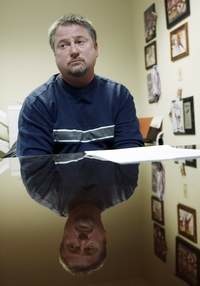
Paul Medlen was one of two workers at Chrysler's Toledo North Assembly plant wounded by Myles Meyers. (THE BLADE/JEREMY WADSWORTH)